
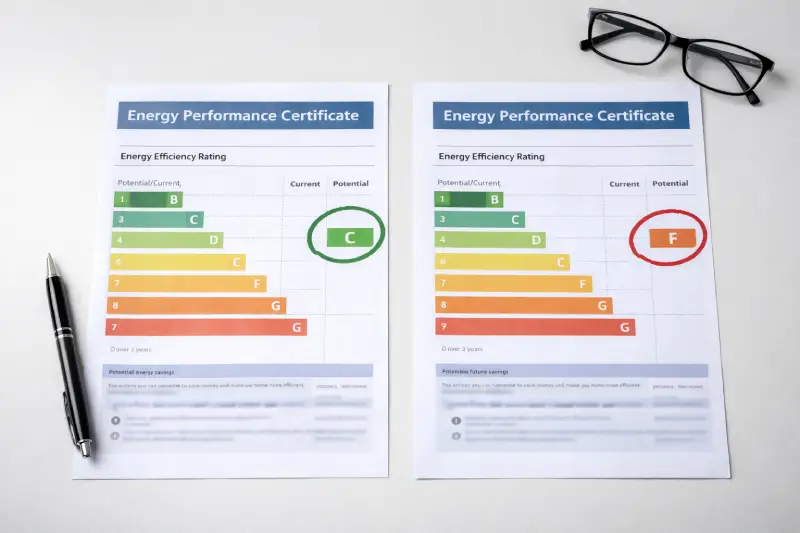
When you search for an EPC and see prices ranging from £35 to £90, the instinct is obvious — go for the cheapest. It is a legal requirement, the certificate looks the same whatever you pay for it, and you have got enough costs to think about with a sale or a tenancy already.
The problem is that a cheap EPC is not the same product as a properly conducted one, even though the document you receive at the end looks identical. And the consequences of an inaccurate certificate — one produced by an assessor who rushed the job, made assumptions instead of checking, or simply did not bother going up into the loft — can be considerably more expensive than the £20 or £30 you saved at the time of booking.
This is not a sales pitch dressed up as advice. It is something I see the effects of regularly, carrying out assessments across Teesside and the North East. People come to us after a cheap EPC has caused them a genuine problem — a grant application rejected, a sale delayed, a landlord compliance issue that should have been caught months earlier. This article explains why that happens and what to look for when you are choosing an assessor.
What a Cheap EPC Usually Means in Practice
An EPC assessment has fixed costs that do not go away simply because an assessor quotes you less. Accreditation body membership, professional indemnity insurance, lodgement software, and the time involved in travel, assessment, data processing, and certificate lodgement all have a floor. When a cheap EPC is offered at a price that does not cover those costs comfortably, something has to give — and in practice, what gives is time spent on site.
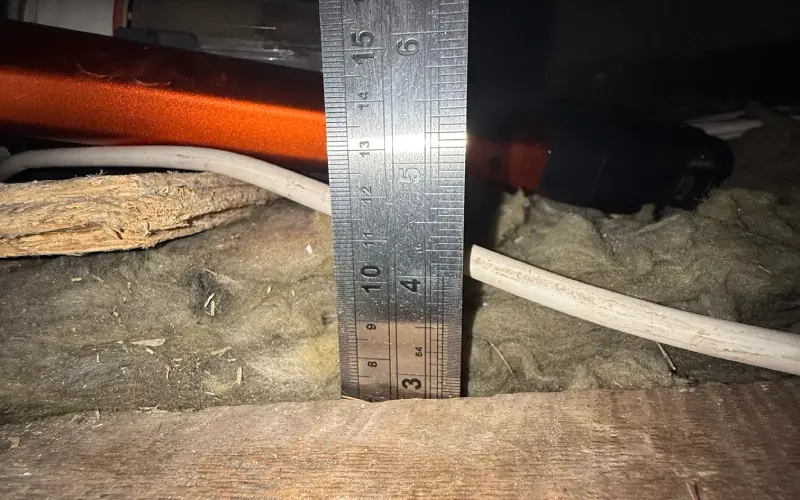
A thorough domestic EPC assessment takes between 35 and 55 minutes for a typical two or three-bedroom property. If an assessor is pricing a cheap EPC at a level that only works economically if they complete four or five assessments in a morning, the maths tells you they cannot be spending that long at each property. What gets cut is the detail: loft access, verification of insulation depths, checking heating control configurations, identifying construction type accurately rather than defaulting to the most common assumption for the area.
Those are not minor details. They are the inputs that determine your SAP score — and therefore your certificate rating. A cheap EPC that applies a default assumption of 100mm of loft insulation when your loft actually has 270mm is going to understate your property’s efficiency. One that misidentifies cavity wall construction as solid wall, or vice versa, can move the rating by a full band in either direction. The certificate looks official and will be lodged on the national register, but the data underpinning it is wrong.
When a Cheap EPC Causes a Real Problem: A Teesside Example
Earlier this year we were contacted by a homeowner in the Thornaby area of Stockton who had purchased a cheap EPC from an online comparison platform roughly six months before calling us. The certificate had come back as a D — which seemed plausible for the property, a 1970s semi with some improvements done over the years. The owner was applying for funding under the Great British Insulation Scheme and had been rejected on the basis of the EPC data.

When we carried out a fresh assessment, the issues became clear almost immediately. The original assessor had not accessed the loft — the hatch was slightly awkward to reach — and had applied a default insulation value. In reality the loft had been professionally insulated to 300mm around eight years earlier, the boiler had been replaced with a modern condensing unit, and there were full heating controls including a programmable thermostat and TRVs on every radiator. None of this had been properly recorded in the cheap EPC.
The corrected certificate came back as a C. The homeowner was now eligible for the grant funding they had originally applied for. The cheap EPC had not saved them money — it had cost them months of delays, a rejected application, and the fee for a second assessment to correct the first one.
The Five Ways a Cheap EPC Can Cost You More
1. An Artificially Low Rating Affects Your Sale Price
Buyers are increasingly using EPC ratings as a negotiating tool. A cheap EPC that undersells your property’s actual efficiency hands them a number to argue with. If the real rating is a C but the cheap EPC says D, you may be conceding thousands in negotiations based on inaccurate data.
2. Grant Applications Get Rejected
As in the Thornaby example above, schemes like the Great British Insulation Scheme and the Boiler Upgrade Scheme use your EPC data as an eligibility reference. A cheap EPC with inaccurate inputs can make you appear ineligible for funding you are fully entitled to — or in some cases create the opposite problem, suggesting eligibility that then falls apart when the scheme’s own surveyors visit.
3. Landlord Compliance Is Undermined
For landlords, a cheap EPC that overstates a property’s rating — recording insulation or heating controls that were not properly verified — creates false compliance. If a local authority audit or a future reassessment exposes the inaccuracy, the landlord is in a significantly worse position than if they had never let the property on the basis of that certificate. The fine exposure and the cost of urgent remediation work far exceed any saving from the cheap EPC itself.
4. Green Mortgage Eligibility Is Affected
A cheap EPC that produces a lower rating than the property deserves can lock you out of preferential green mortgage products. The difference between a C and a B rating, or between a D and a C, can determine whether you access a lender’s best rate or a standard one — a gap that compounds significantly over a 25-year mortgage term.
5. You End Up Paying Twice
The most straightforward cost of a cheap EPC is the most common one: you pay for a second, accurate assessment when the first one causes a problem. The saving from the cheap EPC evaporates entirely, and you have also spent time dealing with whatever consequence the inaccurate certificate created.
What a Properly Conducted Assessment Looks Like
Knowing what you should get for your money makes it easier to judge whether a cheap EPC quote is genuinely competitive or whether something is being cut. A thorough assessment should include:
- Physical access to the loft where safe — not a default value applied from the hatch
- Verification of insulation depths, not just presence
- Accurate identification of construction type — this matters particularly for North East properties with mixed or non-standard build methods
- Recording of all heating controls actually present, not assumed
- Boiler age, type, and fuel confirmed on site rather than estimated
- Certificate lodged to the national EPC register the same day with the reference number provided to you
None of this is above and beyond — it is what a standard assessment should involve. But a cheap EPC at a price point that does not allow time for this level of care will routinely skip one or more of these steps.
How to Spot a Reliable Assessor Who Is Not Just Cheap
Price is not a reliable indicator of quality in either direction — an expensive EPC through an estate agent referral is not automatically better than a fairly priced one from a local independent assessor. What actually tells you something useful:
- Verified accreditation. Every legitimate assessor must be registered with an accreditation scheme — Elmhurst Energy, Stroma, or ECMK are the main ones. Ask for their membership number and verify it. An assessor who cannot provide this should not be carrying out assessments.
- Genuine reviews. Look for Google or Trustpilot reviews that describe the actual visit — how long the assessor spent, whether they went into the loft, whether they asked about work that had been done. Generic five-star reviews tell you very little. Specific ones tell you a lot.
- Same-day lodgement. A reputable assessor lodges the certificate to the register on the day of the inspection and provides you with the reference number. If a cheap EPC provider cannot confirm this timeline, find out why.
- Willingness to answer questions. A good assessor will explain what they found and what the recommendations mean. One who disappears after emailing a PDF and does not respond to follow-up questions is not someone you want responsible for a document that affects a property transaction.
Fair Pricing Across Teesside and the North East
EPCIQ offers EPC assessments at fair, transparent prices across Middlesbrough, Stockton-on-Tees, Hartlepool, Darlington, Redcar, Durham, and the surrounding areas. We are not the cheapest EPC provider in the region, and we do not try to be — because a cheap EPC is only a good deal if the certificate is accurate, and accuracy takes time.
What we do offer is clear upfront pricing, thorough assessments, same-day lodgement, and a certificate you can rely on whether you are selling, letting, or applying for improvement funding. See our local pages for EPC in Middlesbrough, EPC in Stockton-on-Tees, EPC in Hartlepool, and EPC in Ingleby Barwick, or read what our clients have to say on our testimonials page.
Frequently Asked Questions
Is there a minimum price for an EPC in the UK?
There is no legal minimum — assessors can charge whatever they choose. In practice, a cheap EPC at £35 or £40 for a standard property does not cover the realistic cost of a proper assessment once you factor in accreditation, insurance, software, travel, and time on site. That does not mean every cheap EPC is poor quality, but the economics make a thorough job at that price very difficult to sustain.
Can I challenge an EPC if I think it is wrong?
Yes. If you believe the assessor made a factual error — failed to record insulation that is present, applied the wrong construction type, or missed heating controls — you can raise a complaint with their accreditation body. If the error is confirmed, the certificate can be corrected and re-lodged. This is one of the most common follow-on consequences of a cheap EPC done without sufficient care. Our FAQ page covers the process in more detail.
Does a cheap EPC from an estate agent referral carry more risk?
Not necessarily more risk on quality — but estate agent-referred EPCs often carry a significant markup on the actual cost of the assessment. The agent takes a referral fee and passes the work to a subcontracted assessor. You may be paying a non-cheap price for what is effectively a cheap EPC produced by whoever was available and willing to work at the lower end of the market that day. Booking directly with an accredited local assessor removes that middleman.
What is the real cost of a properly conducted EPC in the North East?
For a standard domestic property in the Middlesbrough and Teesside area, a fair price from a thorough local assessor sits between £65 and £95 depending on property size and type. For very large or unusual properties, this price may be slightly higher to reflect the extra work and time on site. That is the range where the economics of a careful, unhurried assessment make sense. Anything materially below that — particularly for larger properties — should prompt questions about what is being cut.
The Bottom Line on Cheap EPCs
A cheap EPC is an appealing option right up until it is not. The certificate is a legal document that affects property transactions, grant eligibility, mortgage rates, and landlord compliance — and its value depends entirely on the accuracy of what was recorded during the inspection. Saving £20 on a cheap EPC that then costs you a grant rejection, a renegotiated sale price, or a compliance fine is not a saving at all.
Book with someone you can verify, whose reviews describe the actual visit, and who will take the time to do the job properly. Get in touch with EPCIQ today — we cover the whole of Teesside and the North East and can usually get to you within 48 hours.
Ready to Book Your EPC?
EPCIQ covers Middlesbrough, Stockton, Hartlepool, Darlington, Redcar, Durham and the whole of the North East. Get in touch today and we will confirm your appointment within 24 hours.